
There are three realms to training a service dog, and all three are incredibly important.
- Basic obedience skills form the foundation for everything else.
- Task training is what technically makes a dog a service animal.
- Public Access Training is essential to the dogs being able to work in public safely and accurately, and helps protect continued access rights.
Mel has been helping owner/handlers train their service dogs for basic obedience skills and public access skills for years, along with selected task training.
Paw In Hand Sidekicks will soon be helping with multiple types of service dogs:
- Medical Assistance
- Balance and Mobility
- Psychiatric or Cognitive
- Hearing dogs may be added as well
What’s the difference?
Medical Assistance, Alert, and Response Dogs
Some service dogs are medical alert dogs, some are medical response dogs, and some do both (medical assistance). It depends on the dog and the person’s needs. These include diabetic alert dogs, seizure alert and/or response dogs, migraine alert dogs, allergy detection dogs, etc.
Mobility Assistance Dogs
These include balance support, light counter-balancing and proprioceptive work, mobility dogs for those in wheelchairs, and more.
Psychiatric or Cognitive Assistance Dogs
These include autism support dogs, psychiatric assistance, PSTD dogs, anxiety dogs, and more.
Do you qualify for a service dog?
To have a service dog, you must be disabled.
This disability must not be temporary (ie: a sprained ankle, broken limb, etc).
It must substantially limit one or more life activities (self-care, performing regular tasks, seeing, hearing, walking, communicating, working, etc).
The tasks you need help with must not be emotional support, physical protection, or companionship. If you need emotional support or companionship, you should instead look into Emotional Support Animals.
The tasks you need help with must be something a dog might be able to do for you (with specific training).
Or, check out this infographic: Do you qualify for a service dog?
Is a service dog the right choice for you?
This is a question Mel will help you explore, if you qualify for a service dog. A service dog is a huge investment, not just in money but also in time and energy. You must be prepared to have your service dog with you a vast majority of the time, and yet also, to still need time to be a dog. You will need to be able to build in down time for your dog in your daily routine. You will also need to be able to feed and care for the dog, not just physically but mentally and financially as well, and if you have an emergency, you need access to a support system who can care for your dog in your stead.
Your service dog will not be perfect. If you need perfection, you will not get it from any service dog. A service dog cannot be your only way to handle your disability, either–service dogs have bad days and off days. They need veterinary care and get sick and injured. You need to be able to have alternate options to mitigate your disability when your dog is out of commission.
And working a dog in public can be stressful, especially for people with anxiety disorders. Sometimes, it can even be dangerous, and you will need to keep an eye on your safety as well as that of your dog. You will need to advocate for yourself and your dog. If the negatives of public access training and encounters with the public outweigh the benefits of your dog’s assistance skills, a service dog is nevertheless not the right choice for you.
Will your dog make a good service dog?
Any breed can be a service dog, provided they can physically do the work required. A chihuahua, for instance, cannot be a balance support dog, but could potentially do the tasks for some medical alerts or allergy detection.
However, a service dog must be able to function and do their job in a public sphere. This means they can’t be overly friendly or nervous of people, pets, or environments. They have to be very well socialized and want to work with their handler. They need to have a steady temperament to handle unexpected situations that can arise; they can’t be overly distracted or excited by wanting to interact with other people, pets, or toys they encounter while working.
They also need to be physically healthy. Service dog work is demanding, even for dogs who aren’t mobility assistance dogs. It’s a lot of mental and physical effort for the dog to be sure they are in the correct positions, responding correctly to cues, and focused on their handler so as to be able to do their tasks.
50-70% of potential service dogs “wash out” of training. Purpose-bred dogs (dogs bred from a lineage of service dogs specifically for service dog work) have a lower rate –about 30-50%, depending on the organization. Dogs from unknown backgrounds (like shelter dogs) or who weren’t specifically bred for this work can still be suited to service dog work, but have a higher chance of washing out of training.
Some (but by no means all) sample reasons dogs have “washed out” of service dog training or work (from a service dog handling group): low working drive (unwillingness to work or not enjoying the work), elbow/hip dysplasia, severe allergies, too friendly, high prey drive/distraction (one was “distracted by birds”), food scavenging, too vocal, too impulsive, high herding drive, high stress/timidity/anxiety in public, noise/light/surface sensitivity or phobia, high energy/no off switch, aggression/reactivity, resource guarding, chronic health issues.
Even after your dog begins working, emergencies could arise that require a dog to retire early, including health issues, changes in behavior, or reactivity/aggression after something stressful like a dog attack. And sometimes, the partnership simply doesn’t work out due to personal reasons, and that’s ok too.
Important! Please remember that not all dogs are suited to service dog work. Most, in fact, are not, and that does not in ay way detract from the companionship they bring or their other positive qualities. For instance, many dogs who aren’t suited to service dog work can make great Emotional Support Animals or Therapy animals (especially those who are too friendly for service work!)
There can be no guarantees that a candidate will work out to be a working service dog.
Statistics
About 1 in 4 people in the US have some sort of disability. Since the US population is about 348,000,000, that’s about 87,000,000 people.
There are an estimated 500,000 service dogs in the US, which is about 1 for every 174 people with disabilities.
Dubuque’s population is about 58,000 people, with about 100,000 in Dubuque County. Grant County, WI is about 53,000 and Jo Daviess County, IL is about 22,000 people. That’s 175,000 people in the immediate tri-state area.
Of those, given the national average, we can expect 43,750 to have some sort of disability, and if 1 in 174 of those has a service dog, that would be 251 service dogs in the tri-state area. Assuming an average working life of 10 years, that’s 25 new service dogs needed per year on average for our area alone.
Already trained service dogs (in the Midwest) can cost the owner/handler $14,000 to upwards of $35,000 (and may cost more to train), though some organizations provide dogs to recipients free of charge due to ample support from donations.
The cost for owners to train their dog with supervision from a trainer/organization (also in the Midwest) for service work can be often be $2,000 to $13,000.
Training a service dog can take 1-2 years, and wait lists for recipients waiting for a fully trained dog can be 2-3 years or sometimes more.
More stats for the curious at: https://gitnux.org/service-dog-statistics/
Resources
About Public Access Rights
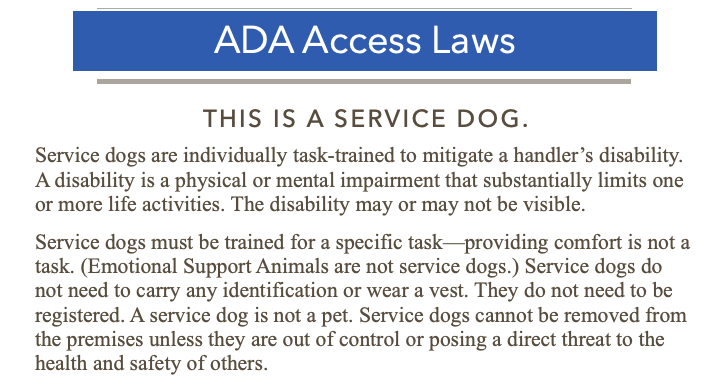
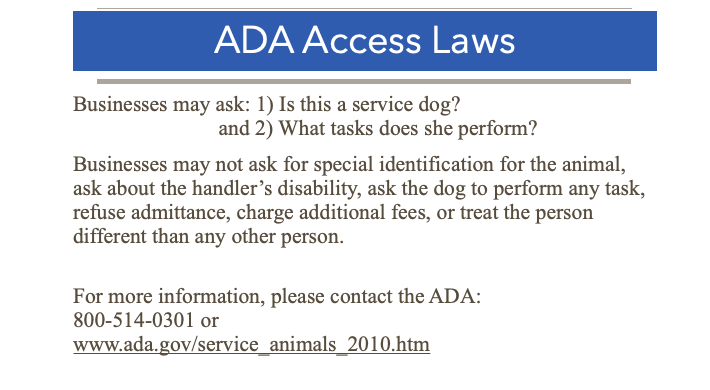
Paw In Hand’s ADA cards — two-sided, shown below. These were written up and designed by Mel and are free to print and reuse.
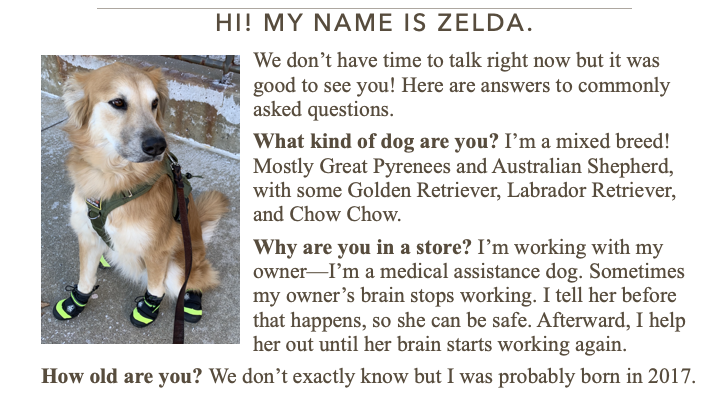
Mel also uses a service dog information card with basic information about Zelda including answers to frequently asked questions. She hands them to kids or other members of the public who are curious when she doesn’t have time to chat.
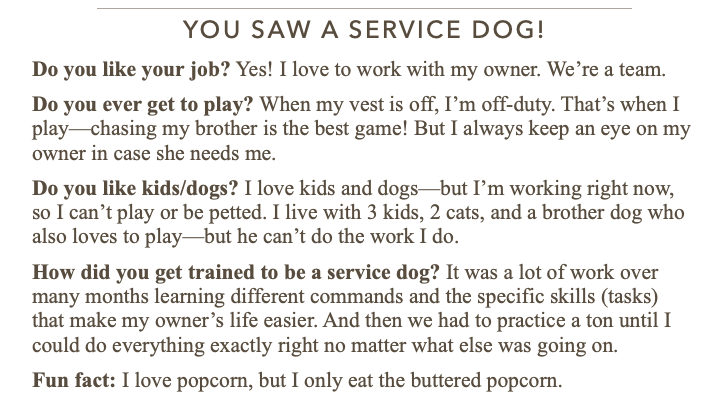
Want your own for your service animal? Mel can create a custom card for you if you’d like!
Other Resources
The International Association of Assistance Dog Partners
Manners Eval for a Service Dog IN TRAINING — from Psych Dog Partners
Psych Dog Partners’ Public Access Test
Work and Task Stories — from Psych Dog Partners
“You’re So Lucky” article by Lesley Nord
Mel’s comparison of various PAT tests with the various CGC testing levels.